


Cedars of God Nature Trails: Bsharri Grove and Qadisha Walks
Ancient cedars on Mount Makmel, a short loop among the oldest trees and longer trails down into the Holy Valley: here is how to walk the Cedars of God.
- Region
- North Lebanon (Bsharri district)
- Time needed
- Half a day, a full day with Bsharri
- Best time to visit
- June to October, winter for snowshoeing
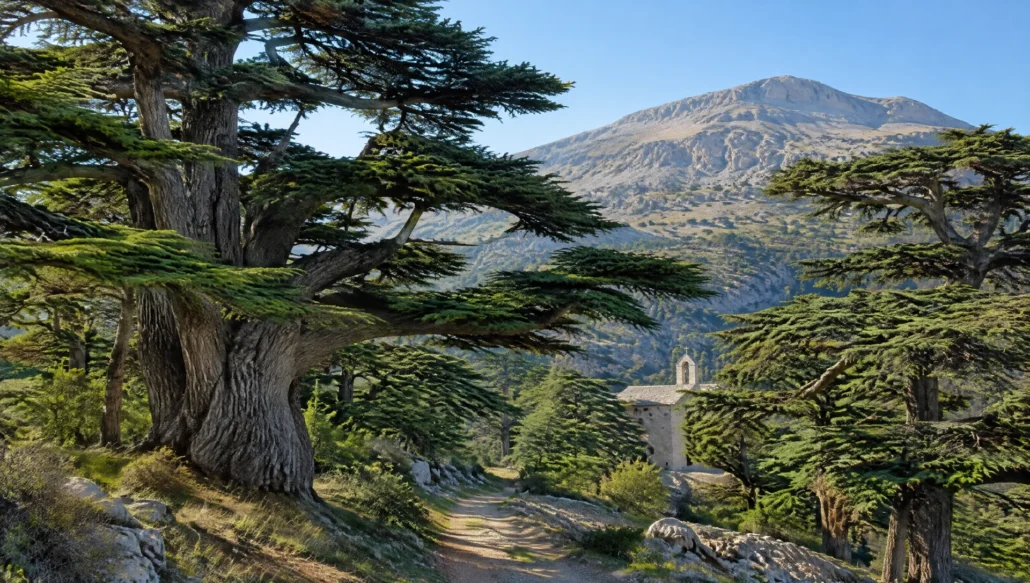
The Forest of the Cedars of God (Arz el Rab in Arabic) is the most famous stand of cedars in Lebanon. It sits at about 1,900 metres on the slopes of Mount Makmel, just east of the town of Bsharri in North Lebanon, and together with the Qadisha valley below it is a UNESCO World Heritage Site. UNESCO describes it as one of the last remnants of the ancient forests that once covered these mountains.
The grove is small, around 10 hectares, which makes it easy to explore on foot in an hour or two. The best way to visit is to combine an easy walk among the trees with one of the longer trails around Bsharri and the Holy Valley.
What makes the grove special
The forest runs from about 1,880 metres at its lowest point to about 1,940 metres on its southern hill. A survey published by the Cedars International Festival counts several hundred mature trees, with the oldest estimated at many centuries, some possibly over a thousand years old, along with more than two thousand young cedars growing up between them. The largest tree, known as the Cedar of God, has a trunk about 18 metres around.
The grove has been protected for a long time. In 1876 a stone wall about 1,300 metres long was built around it, funded by Queen Victoria, to keep goats out and let young trees grow. Inside, the small Church of the Transfiguration stands near the top of the grove, and several dead cedar trunks have been carved into religious sculptures rather than cut down.
Walking trails in and around the Cedars
The grove path
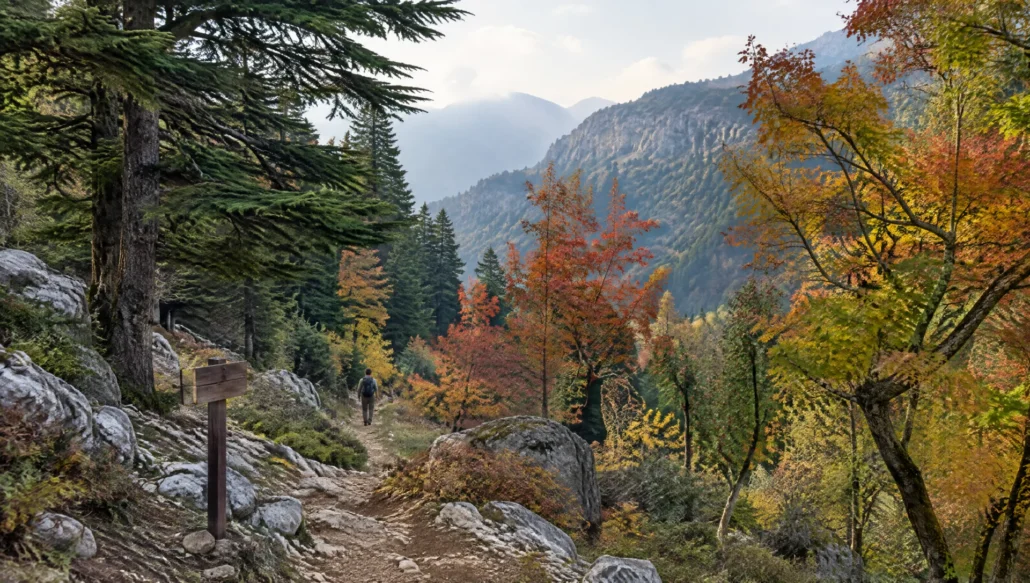
A gentle loop path circles through the forest from the main gate, passing the oldest trees, the chapel and the carved trunks. It is short and mostly easy, suitable for children and older visitors, though the ground is uneven and can be muddy after rain. Allow about an hour, more if you like to sit under the trees.
Bsharri to the Qadisha valley
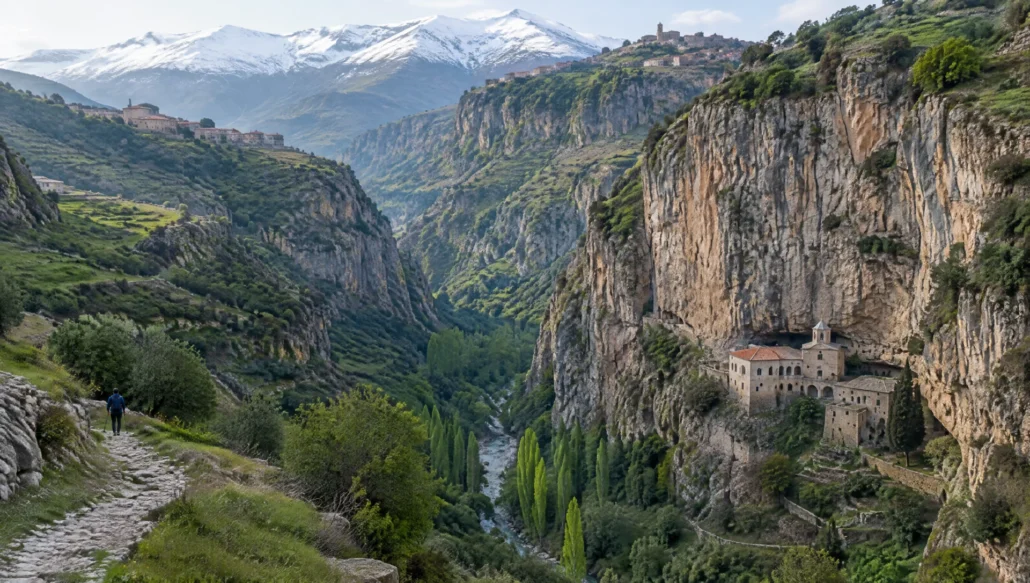
From Bsharri, about 6 km below the Cedars, marked paths drop into the Qadisha valley to the monastery of Mar Lichaa (Saint Elisha), built against the cliff, and continue along the river towards Qannoubine. Going down is easy; coming back up is a steep climb, so plan transport or a guide. Our Qadisha valley guide covers this walk in detail.
Higher ground
Above the grove, the bare slopes climb to Qornet es Sawda, at about 3,088 metres the highest peak in Lebanon. Summer hikes to the summit start from the Cedars area and are best done with a local guide, as there is little shade and weather changes fast. The Lebanon Mountain Trail also passes through the Bsharri area; the Lebanon Mountain Trail Association has route information.
In winter
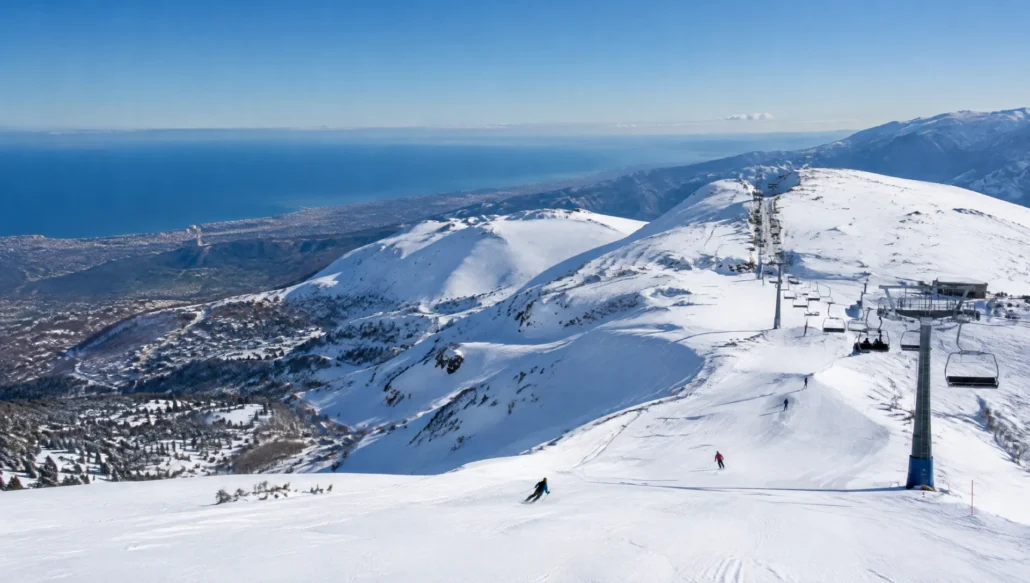
The Cedars ski area sits just above the grove, and snowshoe walks around the forest are popular from January to March. Guided groups run regular trips; it is the most peaceful time to see the trees.
A suggested day
Morning
Arrive early at the Cedars, before tour buses, and walk the grove loop while it is quiet. The light through the branches is softest in the first hours of the day.
Afternoon
Drive down to Bsharri for lunch, then visit the Gibran Museum, set in the old Mar Sarkis hermitage where the poet Gibran Khalil Gibran is buried. If you have energy, walk down to Mar Lichaa in the valley.
Evening
Watch the sun go down over the Qadisha valley from the road between Bsharri and Hasroun, then stay the night in Bsharri or the Cedars village.
Local food and drink
The high valleys around Bsharri are apple country. Les Vergers des Cèdres in Bcharre makes organic apple juice, cider and vinegar from local orchards. The area also has two of the highest vineyards in Lebanon: Mont d’Almaz in Beit Menzer above the Qadisha valley, and Muse du Liban, with vines at about 1,800 metres in Ainata, close to the Cedars. Ask in Bsharri for village restaurants serving kibbeh, mountain bread and local cheese.
Practical tips
- The grove is at 1,900 metres. Even in July the air is cool and the sun is strong, so bring a jacket, a hat and sunscreen.
- Stay on the paths and do not climb trees or take cones or bark. The forest is protected and young trees are fragile.
- The road from Bsharri can be icy in winter; check conditions before driving up.
- Souvenir stalls sit near the entrance. Buy cedar crafts from shops that use fallen or dead wood, not cut trees.
- Weekends in summer are busy. A weekday visit is calmer.
Nearby
Ehden and the Horsh Ehden Nature Reserve are less than an hour away; see our Horsh Ehden guide. For another cedar walk, the Tannourine cedar forest is south of here.