

How to Make Homemade Lebanese Kanafa (Knefeh bi Jibneh)
A crisp, buttery crust over a layer of soft, stretchy white cheese, soaked at the last minute with cold scented syrup. This is the knefeh Lebanese families line up for on a Sunday morning.
- Prep time
- 30 minutes (plus 2 hours to desalt the cheese)
- Cook time
- 30 minutes
- Serves
- 8
- Difficulty
- Medium
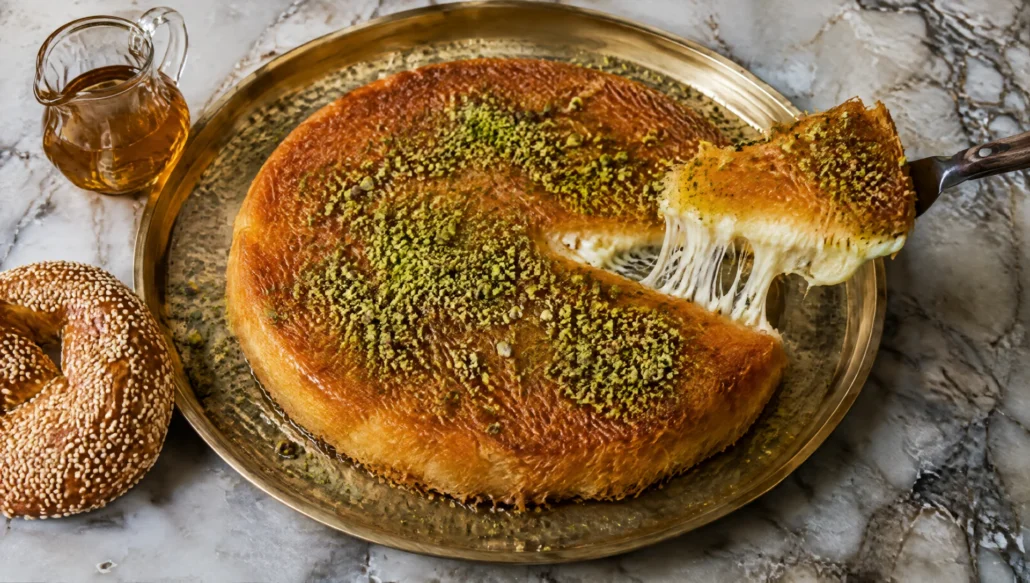
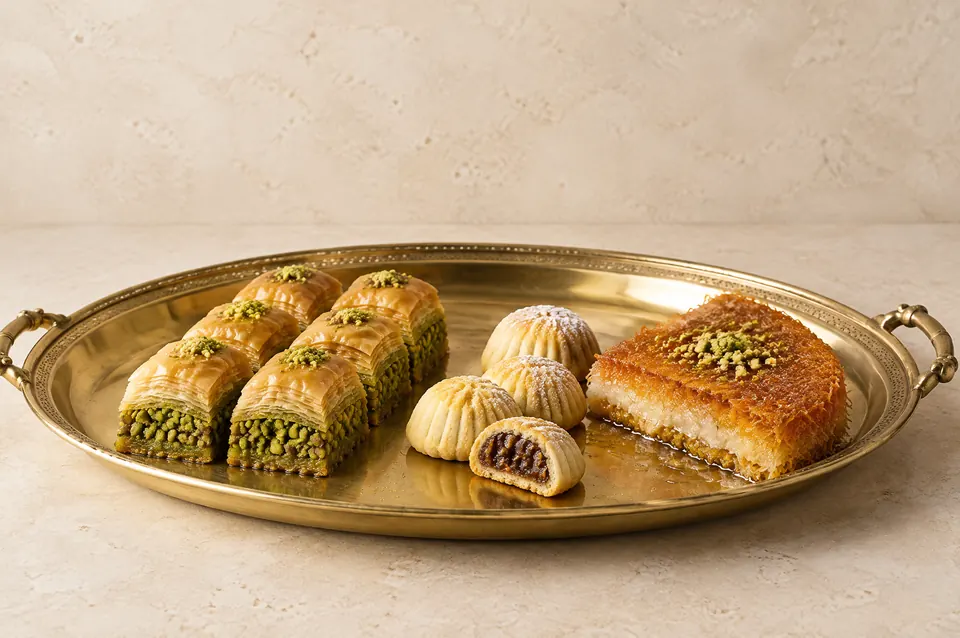
Kanafa (knefeh in Lebanese dialect) is a warm cheese pastry: a golden layer of shredded dough on top, a thick layer of mild melting cheese underneath, and sugar syrup scented with orange blossom poured over just before serving. Tripoli is its capital in Lebanon, and old sweet houses there still serve it in the morning, often tucked into a sesame ka’ak bun as a breakfast sandwich. At home it is a weekend treat, a dessert for guests, and a favourite during Ramadan evenings.
What makes a good knefeh is contrast: a crust that stays crisp, cheese that stretches without turning rubbery or salty, and syrup that is cold when it meets the hot pastry, so it soaks in without making the crust soggy. This home version uses kataifi (shredded pastry dough), pulsed fine to imitate the smooth “naameh” crust of Tripoli bakeries.
Ingredients
For the syrup (ater)
- 300 g (1½ cups) granulated sugar
- 180 ml (¾ cup) water
- 1 teaspoon lemon juice
- 1 tablespoon orange blossom water
- 1 teaspoon rose water
For the crust
- 250 g (½ lb) kataifi (shredded pastry dough), thawed if frozen
- 115 g (½ cup, 1 stick) unsalted butter or ghee, melted
- 2 tablespoons granulated sugar
For the cheese layer
- 300 g (10 oz) akkawi cheese
- 200 g (7 oz) fresh mozzarella, drained and patted dry
- 2 tablespoons granulated sugar
To finish
- 2 tablespoons finely ground pistachios
Instructions
- Desalt the cheese: cut the akkawi into small cubes and soak it in a bowl of cold water for about 2 hours, changing the water every 30 minutes. Taste a piece; it should be mild, with only a faint saltiness. If you are short on time, slice it thinly and soak for 1 hour with frequent water changes.
- Make the syrup: put the sugar, water and lemon juice in a small saucepan over medium heat. Stir until the sugar dissolves, then let it boil gently without stirring for 6 to 8 minutes, until slightly thickened (it should coat a spoon like thin honey). Take it off the heat, stir in the orange blossom and rose water, and let it cool completely. Chill it if you can.
- Heat the oven to 190°C (375°F) with a rack in the lower third.
- Pulse the kataifi in a food processor in short bursts, about 10 to 15 times, until it looks like coarse crumbs with no long strands.
- Tip the crumbs into a bowl, pour over the melted butter and add 2 tablespoons of sugar. Rub everything together with your fingers for a minute or two, until every crumb is coated and the mixture holds when squeezed.
- Brush a 25 to 28 cm (10 to 11 inch) round pan with a little butter. Press the dough firmly and evenly over the base and about 1 cm (½ inch) up the sides, using the bottom of a glass to compact it.
- Drain the akkawi very well and squeeze out the water. Grate or tear it with the mozzarella, mix in 2 tablespoons of sugar, and spread it over the crust, leaving a 1 cm (½ inch) border. Press it down lightly.
- Bake for 25 to 30 minutes, until the cheese has melted and the edges of the crust are deep golden. Lift one edge with a thin spatula to check that the underside is golden too.
- Let it rest for 2 minutes, then run a knife around the edge, put a serving platter on top and flip it over in one confident movement so the crust is on top.
- Pour about half of the cold syrup over the hot knefeh, sprinkle with pistachios, and serve right away in wedges, with the rest of the syrup at the table.
Tips for the best kanafa
- Cold syrup on hot pastry is the rule. Warm syrup on warm knefeh gives a soggy crust.
- Taste the cheese after soaking. Salty akkawi is the most common reason homemade knefeh disappoints.
- Dry the mozzarella well; extra moisture makes the cheese layer watery.
- Many bakeries tint the crust orange. A tiny pinch of orange food colouring rubbed into the butter does the same, but it is optional.
How to serve and store
Serve knefeh hot, while the cheese still stretches. For the Tripoli breakfast version, split a warm sesame ka’ak or a soft bun, spoon in a wedge, and add a drizzle of syrup. Leftovers keep in the fridge, covered, for 2 days. Reheat in a 180°C (350°F) oven for 10 to 12 minutes until the cheese softens again, then add fresh syrup.
Variations
- Knefeh with ashta: replace half of the cheese with thick ashta cream for a softer, milkier filling.
- Shredded crust (knefeh khishneh): skip the food processor and use the strands whole for a crunchier top.
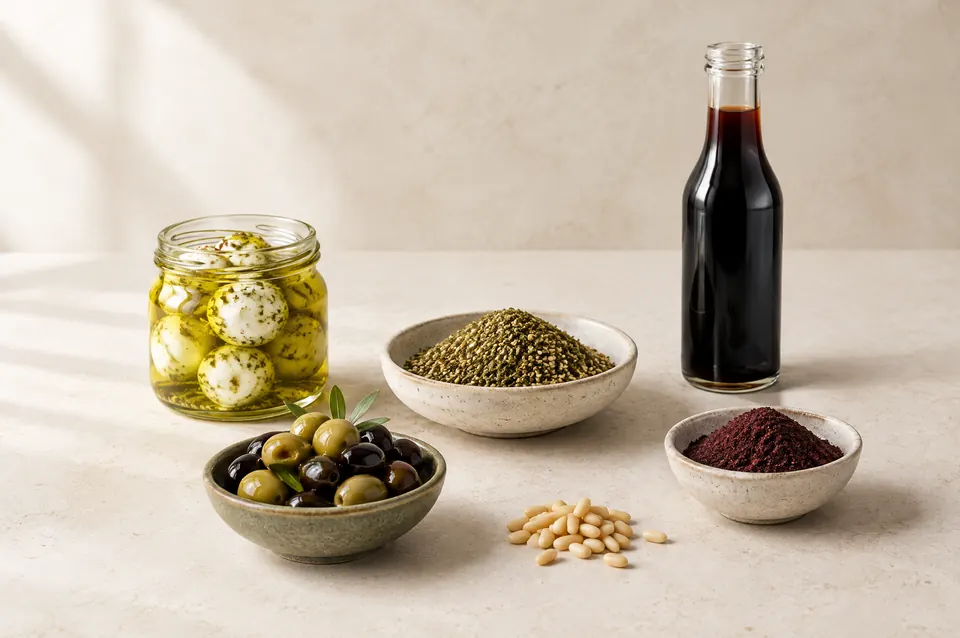
For orange blossom and rose water, look for Lebanese producers such as Cortas, and for village cow-milk akkawi, Bionord in Koura. If you would rather taste the real thing first, Tripoli’s Abdul Rahman Hallab & Sons 1881 has been making knefeh since the nineteenth century.