

Top 10 Landmarks to Visit in Lebanon, From Baalbek to Byblos
Roman temples, a Crusader castle, a sea arch and a grove of ancient cedars: these ten landmarks explain Lebanon in a single trip.
- Region
- Across Lebanon
Lebanon packs Roman temples, Phoenician ports, Crusader castles, Ottoman mosques and ancient cedar groves into a country you can cross by car in a few hours. That density is the whole point: in one long weekend you can stand under the columns of Baalbek, walk the harbour of Byblos and watch the sun set behind Pigeon Rocks in Beirut.
These ten landmarks are the ones that best explain the country, its history and its landscape. Each entry includes a practical tip so you can fit it into a real itinerary.
How we chose
We kept the original list’s picks that hold up, corrected the facts using UNESCO, official sites and published histories, and grouped the two downtown Beirut sights together to make room for the Cedars of God, which belongs on any list of Lebanon’s landmarks. We left out anything we could not verify.
1. Baalbek (Bekaa Valley)
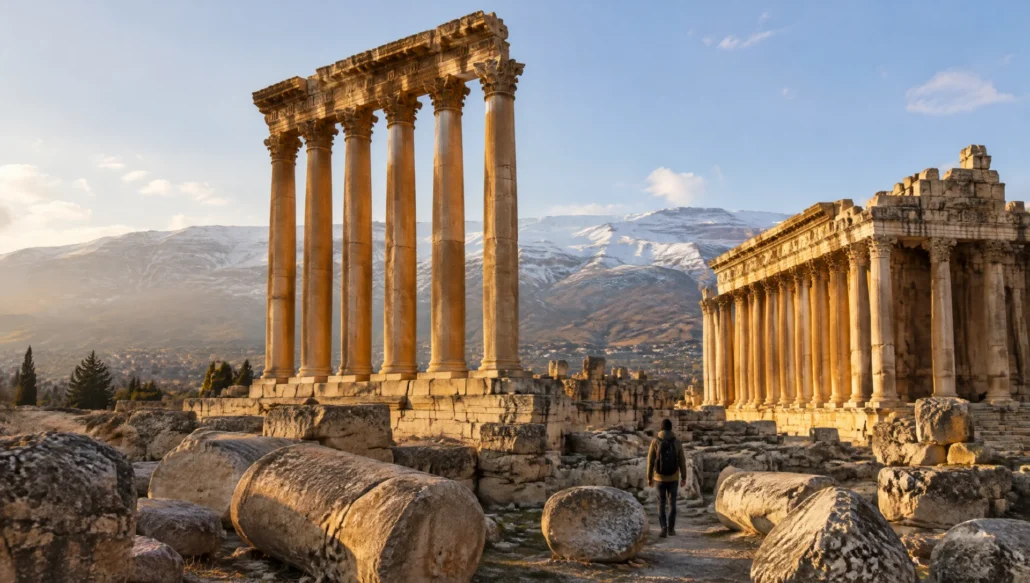
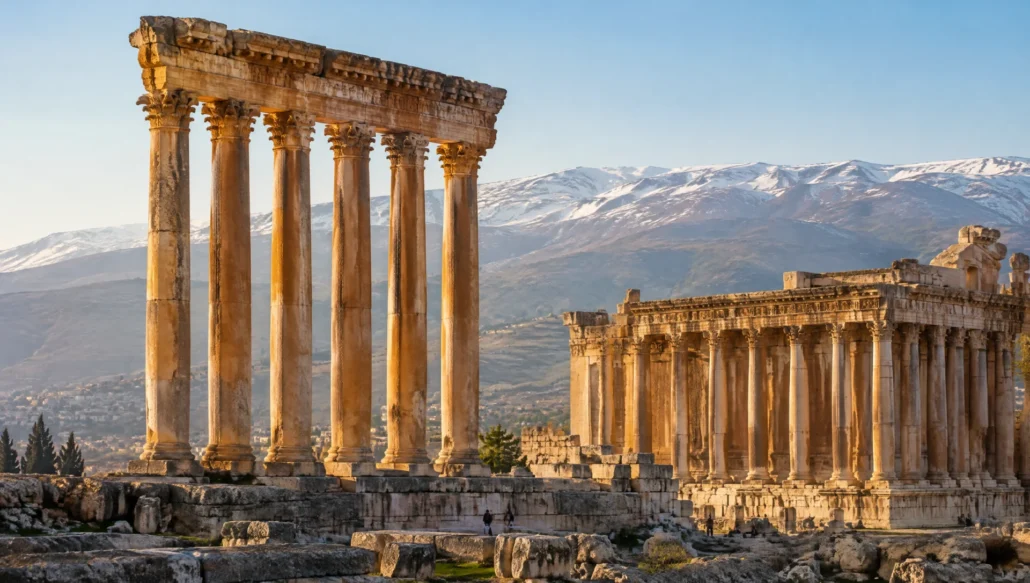
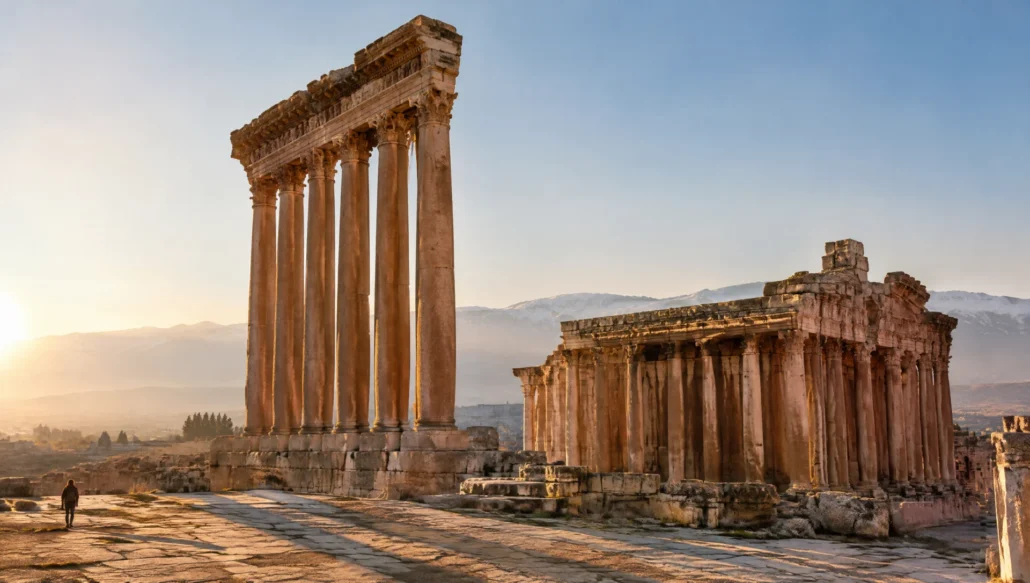
The temple complex of Baalbek, called Heliopolis by the Greeks and Romans, is one of the great sites of the Roman world and a UNESCO World Heritage site. The six standing columns of the Temple of Jupiter, the main temple of the Heliopolitan triad, rise above a terrace of enormous cut stones. Next door, the Temple of Bacchus is one of the best preserved Roman temples anywhere, with a carved gateway covered in vines and Bacchic figures. The small round Temple of Venus sits just outside the main enclosure.
Give it at least half a day and go early to beat the heat. In summer, the Baalbeck International Festival stages concerts among the temples. For a simple overnight a few steps from the entrance, there is Baalbak Guesthouse.
2. Byblos Citadel and Old Town (Jbeil)
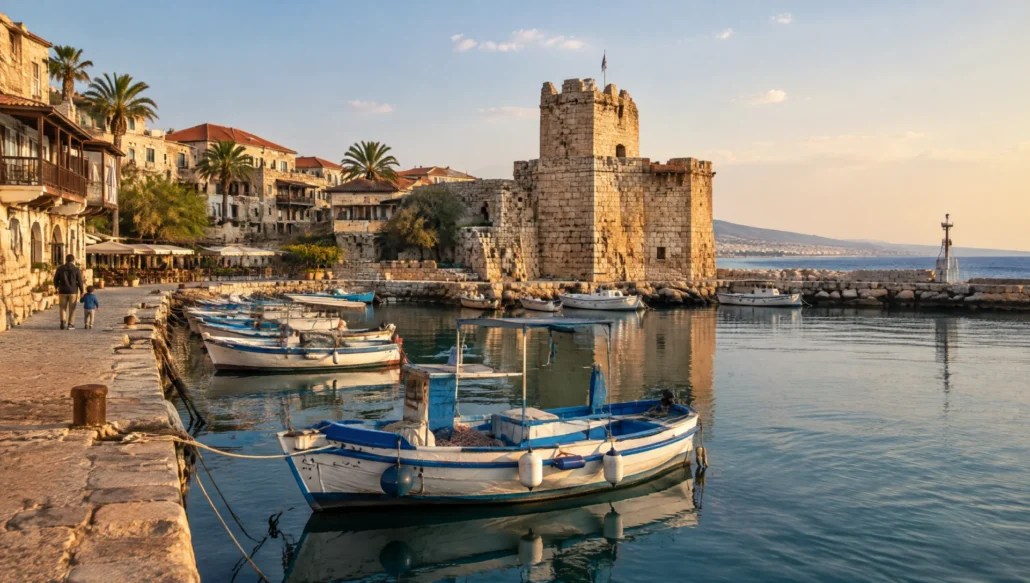
Byblos, about 40 km north of Beirut, is one of the oldest continuously inhabited towns in the world and a UNESCO site. The Crusader castle at its centre is built partly from older Roman stones, and from its walls you look over layers of ruins: Bronze Age temples, Persian fortifications, a Roman road and theatre, and the royal necropolis where the sarcophagus of King Ahiram, carrying one of the earliest Phoenician inscriptions, was found.
After the site, walk the restored souk, see the Crusader church of St John-Marc and finish at the small fishing harbour. In summer, check the programme of the Byblos International Festival, held by the sea beside the castle.
3. National Museum of Beirut (Beirut)
Inaugurated in 1942, the National Museum sat on the civil war’s front line, and its staff protected the collection by walling objects in and encasing large pieces in concrete. Today it is the best introduction to Lebanese archaeology. The prize is the sarcophagus of Ahiram, King of Byblos, which bears one of the earliest known examples of the Phoenician alphabet. Look also for the ex-voto statues of children from the Temple of Eshmoun near Sidon and the large Roman mosaics.
It is compact enough for a two-hour visit. Watch the short film about how the collection survived the war before you go in; it makes everything you see afterwards more moving.
4. Pigeon Rocks, Raouché (Beirut)
Two huge limestone rocks stand just off the cliffs of Raouché, on Beirut’s western tip. They are the city’s best-known natural landmark and the end point of the seafront Corniche, where families walk, fish and drink coffee every evening.
Come about an hour before sunset. Walk the Corniche from Ain el Mreisseh, then sit at one of the cliff-side cafés on Avenue de Paris. In calm weather, small boats leave from the cove below to pass through the arch.
5. Martyrs’ Square and the Mohammad al-Amin Mosque (Downtown Beirut)
Martyrs’ Square is named for nationalists executed under Ottoman rule in 1916, and its bronze statue still carries bullet holes from the civil war. It has been the scene of the country’s largest gatherings, from celebrations to protests. On its edge stands the Mohammad al-Amin Mosque, inaugurated in 2008, with blue domes and minarets 72 metres high in an Ottoman style. Former prime minister Rafic Hariri, who helped fund it, is buried beside it.
The Maronite Cathedral of St George stands right next to the mosque, its bell tower built to the same height as the minarets. Visitors can enter the mosque outside prayer times; women should cover their hair and everyone should dress modestly.
6. Our Lady of Lebanon (Harissa)
About 650 metres above Jounieh Bay, the white bronze statue of the Virgin has stretched her arms toward Beirut since 1908. Christians and Muslims both visit the shrine, and the view over the bay and the coast is one of the best in the country.
Ride the Téléphérique cable car up from Jounieh for the full experience, or drive the mountain road. Go late in the afternoon when the light softens over the water.
7. Jabal Moussa (Keserwan)
Jabal Moussa is a UNESCO biosphere reserve on the western slopes of Mount Lebanon, above the Nahr Ibrahim valley, with views down to the Mediterranean. It is a landmark of a different kind: a protected mountain of oak and pine, Roman stairs, old terraces and trails maintained by a local association that works with surrounding villages.
Spring is the best season for wild flowers. The Jabal Moussa Biosphere Reserve runs guided walks and can arrange lunch and village guesthouses.
8. Moussa Castle (Chouf)
On a hill between Deir el Qamar and Beiteddine, Moussa Castle is a modern landmark with a personal story. Moussa Abdel Karim al-Maamari built it to his own design, laying the first stone in 1962 and opening it to the public in 1969. Inside, life-size scenes show traditional Lebanese village crafts and daily life, alongside the collections he gathered over the years.
Combine it with Beiteddine Palace, the 19th-century residence of Emir Bashir II, and the stone streets of Deir el Qamar. Stay the night in a restored house such as Beyt El Jabal.
9. Citadel of Raymond de Saint-Gilles (Tripoli)
Locals call it Qalaat Sanjil. The Crusader count Raymond de Saint-Gilles began the fortress between 1102 and 1109 while besieging Tripoli. It was later rebuilt under the Ottomans and restored again in the early 19th century, and it still dominates the hill above the old city.
From the walls, look down on the Mamluk souks, khans and mosques of old Tripoli, then walk down into them. End with sweets at Rafaat Hallab 1881, part of the family tradition Tripoli is known for.
10. The Cedars of God (Bsharri)
Above Bsharri, at the head of the Qadisha Valley, the Cedars of God grove is one of the last remnants of the ancient cedar forests that once covered Mount Lebanon. The cedar is on the national flag, and its wood was prized in antiquity for temples and ships. The grove and the valley below are listed together as a UNESCO World Heritage site.
A walled path loops through the oldest trees in under an hour. In winter the grove is often under snow and the nearby slopes become a ski area, so check road conditions before driving up.
Tips
- Spring and autumn are ideal. Summer is hot at Baalbek and on the coast, while the Cedars can be snowbound in winter.
- Carry your passport or ID: you may pass army checkpoints, especially on the road to Baalbek.
- Dress modestly for mosques, churches and shrines.
- Pair landmarks by region: Byblos with Harissa, Deir el Qamar with Moussa Castle, Bsharri with Qadisha.
- Check current travel advice before visiting the Bekaa and the north, as conditions can change.
- Carry small cash for entry tickets, which are usually paid on site.