
How to Make Lebanese Baklava with Pistachios and Ater Syrup
Crisp layers of phyllo, a generous nut filling and a light syrup scented with orange blossom. Lebanese baklava is less sticky than you might expect, and that is the point.
- Prep time
- 40 minutes
- Cook time
- 50 minutes, plus 4 hours resting
- Serves
- About 35 pieces
- Difficulty
- Medium
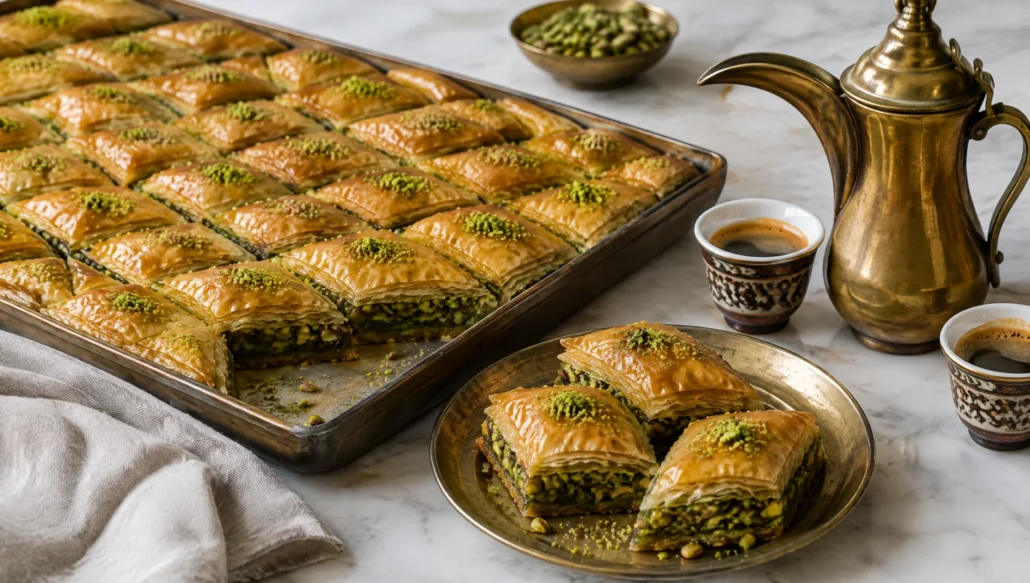
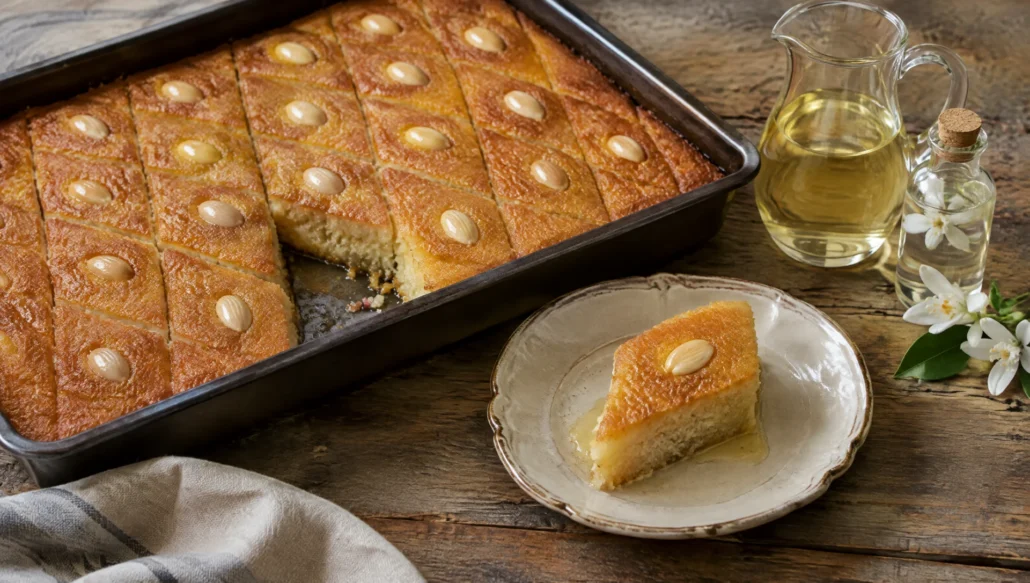
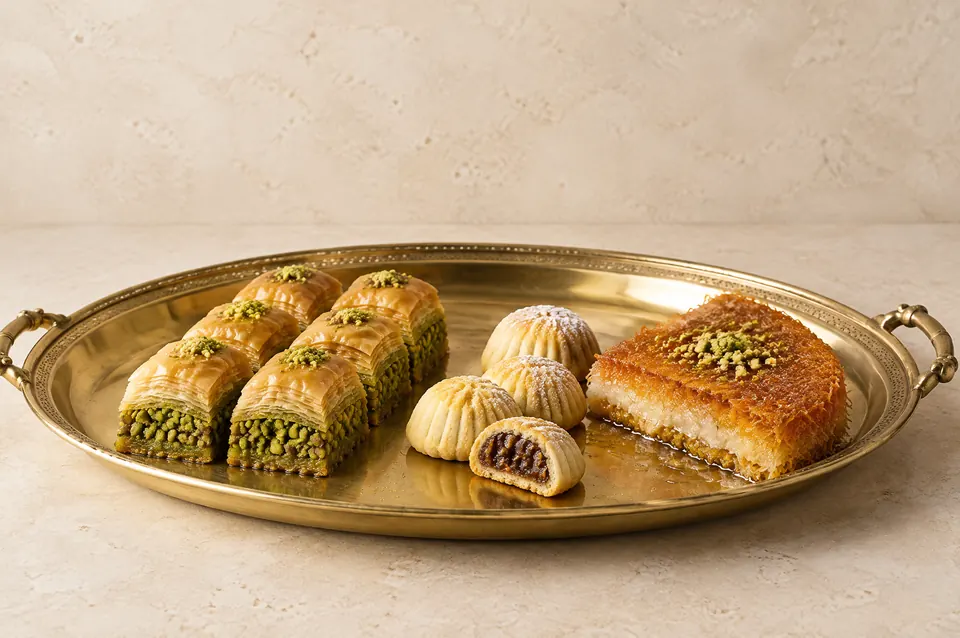
Baklawa, as it is said in Lebanon, sits on every tray of sweets brought to a house during Eid, Christmas, Easter or a new baby’s visit. The big sweet shops of Tripoli, Beirut and Saida sell it in dozens of shapes (fingers, bird’s nests called ish el bulbul, diamonds, rolled cigars), but the home version is a simple tray of buttered phyllo layered with nuts and cut into diamonds.
The Lebanese style has its own character. It leans on pistachios or cashews, it uses clarified butter (samneh) for a clean, nutty flavour, and the syrup (ater) is lighter and perfumed with orange blossom water or rose water rather than honey or cinnamon. The result should be crisp on top, moist at the base, and never drowning in syrup.
Ingredients
For the syrup (ater)
- 400 g (2 cups) granulated sugar
- 240 ml (1 cup) water
- 1 tsp lemon juice
- 1 tbsp orange blossom water (mazaher)
- 1 tsp rose water (maward), optional
For the baklava
- 450 g (1 lb) phyllo dough, thawed overnight in the fridge
- 225 g (1 cup) clarified butter or ghee, melted (or 280 g / 1 1/4 cups butter, clarified)
- 350 g (about 3 cups) raw unsalted pistachios or walnuts, or a mix
- 50 g (1/4 cup) granulated sugar
- 1 tbsp orange blossom water
- 2 tbsp finely ground pistachios, to finish
Instructions
- Make the syrup first so it has time to cool. Put the sugar and water in a saucepan over medium heat and stir until the sugar dissolves. Bring to a boil, add the lemon juice and simmer without stirring for 8 to 10 minutes, until it coats a spoon like thin honey. Turn off the heat, stir in the orange blossom and rose water, and let it cool completely.
- Pulse the nuts in a food processor until coarsely chopped, about the size of lentils, with no powder. Stir in the 50 g sugar and the orange blossom water.
- Heat the oven to 175°C (350°F) with a rack in the lower third. Brush a 23 x 33 cm (9 x 13 in) metal pan with melted butter.
- Unroll the phyllo and trim the stack to fit the pan if needed. Cover it with a sheet of baking paper and a damp towel so it does not dry out while you work.
- Lay one sheet in the pan and brush it lightly with butter. Repeat until you have used half of the sheets (about 10 to 12 sheets, depending on the brand).
- Spread the nut mixture evenly over the phyllo and press it down gently with your palm.
- Layer the remaining sheets on top, brushing each with butter. Brush the top sheet generously.
- With a very sharp knife, cut all the way to the bottom of the pan: make 5 long cuts lengthwise (6 strips), then cut diagonally across to form diamonds. Cutting before baking is essential, because baked phyllo shatters.
- Pour any remaining butter over the cuts and let it settle for 5 minutes.
- Bake for 45 to 55 minutes, until the top is deep golden and the layers along the cut lines are golden too. Rotate the pan halfway through.
- As soon as it comes out of the oven, slowly pour the cooled syrup over the hot baklava, focusing on the cut lines. You will hear it sizzle. Start with three quarters of the syrup and add the rest if the base looks dry.
- Sprinkle with ground pistachios and leave uncovered at room temperature for at least 4 hours, or overnight, before serving.
Tips for the best baklava
- Cold syrup on hot pastry (or the reverse) keeps the layers crisp. Never pour hot syrup on hot baklava.
- Clarified butter gives a crisper, longer-lasting result than whole butter, which contains water.
- A metal pan browns the bottom layers better than glass.
- Do not cover baklava while it is warm. Trapped steam softens the top.
How to serve and store
Serve at room temperature with Lebanese coffee or mint tea. Store in a tin or loosely covered container at room temperature for up to a week. Avoid the fridge, which hardens the syrup and dulls the pastry. For gifts, place each diamond in a small paper case, the way sweet shops do.
Variations
For cashew baklava, swap all the nuts for cashews and use rose water in both the filling and the syrup. For a less sweet tray, cut the syrup by a third. Some families add a pinch of ground mahlab or a little ground cardamom to the nuts.
Good flower waters make the difference here. Cortas and Al Yaman both make the orange blossom and rose water found in Lebanese kitchens. If you want to compare your tray with the classics, Tripoli’s Hallab 1881 has been making baklawa since the nineteenth century.