

The Best Mountain Bike Trails in Lebanon: 7 Rides to Try
From cedar forest loops in the Chouf to rocky high plateaus below Sannine, these are the mountain bike areas Lebanese riders keep coming back to.
- Region
- Mount Lebanon and North Lebanon
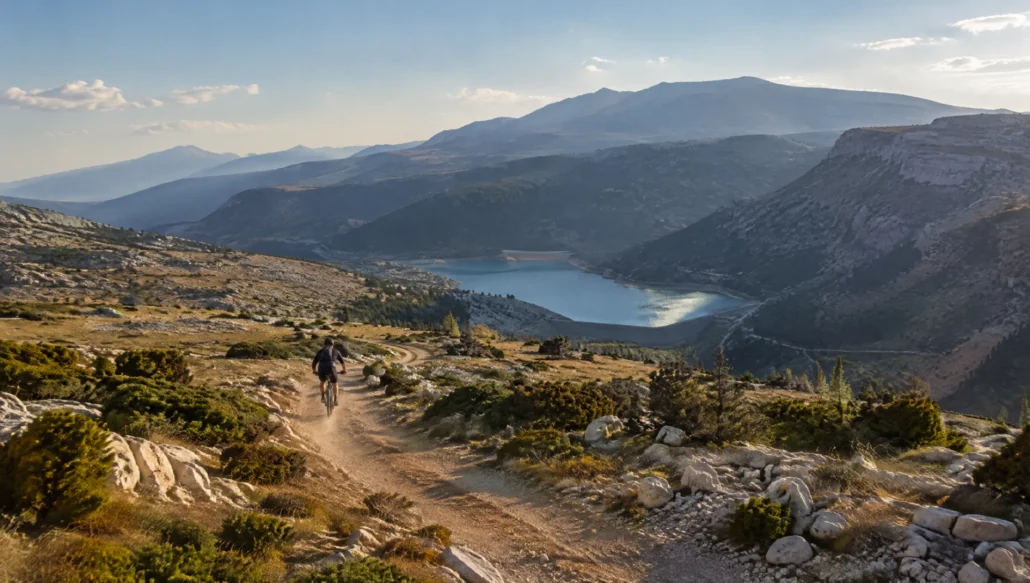
Lebanon packs a lot of mountain into a short distance. Within an hour of the coast you can be riding at 1,500 to 2,000 m on high plateaus of limestone, juniper and snow-fed springs, with the Mediterranean on one side and the Bekaa Valley on the other. Most mountain biking here happens on a mix of farm tracks, old dirt roads, quiet village asphalt and, for experienced riders, rocky singletrack.
The rides below cover the main areas local riders return to, from easy forest loops in the Chouf to hard, rocky days around Sannine.
How we chose
We kept the routes from the old version of this page, which are all real riding areas, and checked them against reserve information, Lebanon Mountain Trail section descriptions and recorded GPS rides. We removed exact distances and surface percentages we could not confirm, because many routes have several variants. Trails change after winter storms, so treat these as areas to explore with a local GPS track or guide, not as fixed courses.
1. Barouk and the Shouf Biosphere Reserve (Chouf)
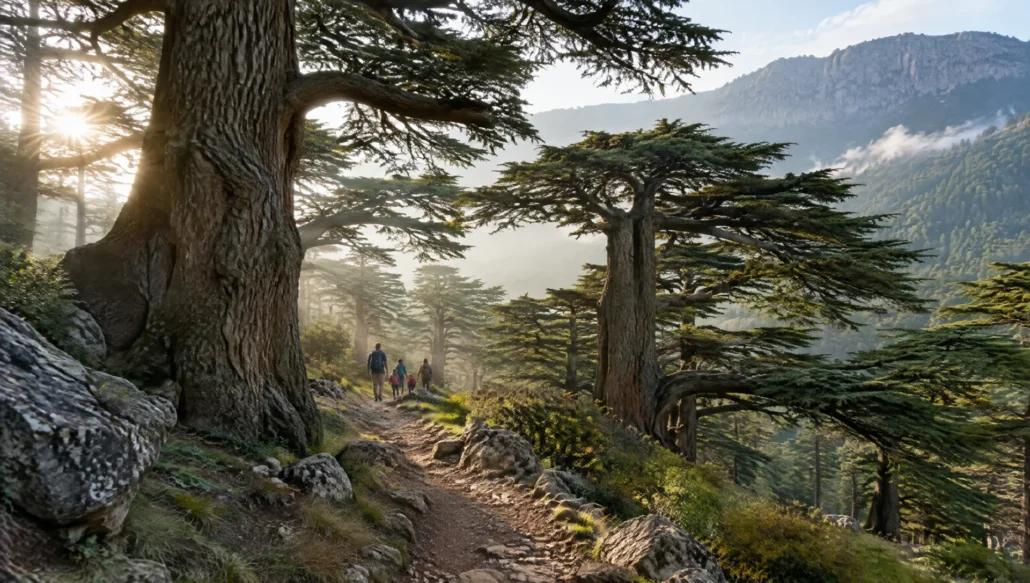
The Shouf Biosphere Reserve covers about 500 km² of the Chouf mountains, roughly 5% of Lebanon, and protects some of the country’s largest remaining cedar forests at Barouk, Maasser el Chouf and Ain Zhalta. The reserve actively promotes cycling and offers bike rental, which makes it the most organised place in the country to start.
The classic local ride is the climb from the Barouk side up toward the ridge and its antenna, a long, steady ascent on mostly paved and graded road with big views over the Chouf, then a return on the same line or on dirt tracks. Tip: the reserve has fixed entrances and rules on where bikes can go, so ask at the entrance and stick to permitted tracks inside the cedar forest.
2. Marj Baskinta (Metn)
Below the slopes of Sannine, the meadows and orchards around Baskinta are crossed by dirt farm roads that make a natural playground for riders. Local groups ride two main loops: an easier one with gentle descents and a few short, steep climbs, and a longer, more demanding one that heads higher up the mountain.
Baskinta is also the start of one of the official side trails of the Lebanon Mountain Trail, and the village has a literary history (it was home to the writer Mikhail Naimy). Tip: spring, after the snow has gone, is the greenest time, but tracks can stay muddy into April.
3. Warde to Wata el Jozz (Keserwan)
Warde lies in the high Keserwan country near Faraya and Chabrouh, and the descent and climb toward Wata el Jozz is one of the tougher rides in Keserwan. Expect steep sections, loose rock and long climbs that reward strong legs.
It is a route for fit riders who are comfortable pushing on the steepest bits. Tip: carry more water than you think you need; there is little shade on the high ground in summer.
4. Zaarour, Majdel Tarchich and Sannine (Metn)
The high country between the Zaarour ski area, Majdel Tarchich and the foot of Mount Sannine is rocky, exposed and technical. This is the hardest riding on this list, with sharp limestone, rough descents and few easy bail-out points.
It suits experienced riders with good bike-handling skills and full protective gear, and it is not a place for children or beginners. Tip: ride with someone who knows the area, and avoid it in fog, which can roll in quickly on these plateaus.
5. Falougha and Jabal el Kneisse (Metn)
The ridge above Falougha, followed by Section 17 of the Lebanon Mountain Trail, looks east over the Bekaa plain and west toward Beirut and Hammana. Recorded rides here sit at roughly 1,450 to 1,600 m, and riders describe it as moderate on foot but harder on a bike, with some technical and muddy sections. Along the way you pass remains of French Second World War trenches.
A gentler option is to stay on the paved and dirt roads around Jabal el Kneisse and the water reservoir, which still give the big views. Tip: the gate to the Falougha cedar reserve is sometimes closed, so be ready to ride around it.
6. Chabrouh, Warde and Faraya (Keserwan)
Around the Chabrouh dam above Faraya, a network of quiet roads and tracks links the dam, Warde and Faraya village. Most of it is smooth and manageable, with only a few short steep pitches where you might push, so it is a good choice for intermediate riders and fit beginners.
Section 13 of the Lebanon Mountain Trail starts near the dam and runs to Kfardebian past the Nabaa el Laban spring, the natural stone bridge of Jisr el Hajar and the Roman ruins at Faqra. It is a hiking route, but parts of it make a lovely ride and the sights are worth a stop. Tip: in winter this is ski country; ride from late spring to autumn.
7. Horsh Ehden Nature Reserve (Zgharta, North Lebanon)
Above Ehden, Horsh Ehden Nature Reserve protects about 17 km² of mixed forest with cedar, Cilician fir, juniper and the rare Lebanese wild apple. It holds nearly 40% of Lebanon’s native plant species in a tiny area, and the reserve lists mountain biking among its activities alongside hiking and birdwatching.
Riding here is more about forest atmosphere and cool summer air than speed. Tip: check with the reserve about which tracks are open to bikes, and pair the ride with a night in Ehden.
Riding with a group
If you are new to Lebanon, the easiest way in is with a local club or outfitter that already knows the tracks and has a support car. Adventure operators such as 33North and clubs like Footprints Nature Club run outdoor trips across the mountains, and the Lebanon Mountain Trail Association can provide GPS tracks and advice for its sections.
Tips
- Ride between April and November; high routes are under snow in winter.
- Start early in summer. Midday sun on the plateaus is strong and there is little shade.
- Always wear a helmet and carry a repair kit, spare tube and enough water; bike shops are far from most trails.
- Download an offline GPS track before you go. Mobile signal drops in valleys.
- Do not ride routes in reverse on narrow sections shared with hikers, and give way to walkers and herds.
- Close any farm gates you open and stay off cultivated terraces.
Need gear first? See our guide to the best bicycle shops in Lebanon, and for road riding, the best cycling routes in Lebanon.